
Oki Signs
In 2019, the City of Lethbridge Heart of Our City Committee and the Reconconciliation Lethbridge Advisory Committee partnered to develop an OKI sign as part of the 2019 United Nations International Year of Indigenous Languages and the adoption of “Oki” as the official greeting of the City of Lethbridge.
From the two original OKI signs in 2019, this initiative has grown to two further rounds of signage and the inclusion of meaningful art by Indigenous artists on the face of the sculptures.
Ohkanaomowoo: Gathering Together, Mariah (Omah’kaistaawakaakii) Gladstone, 2025
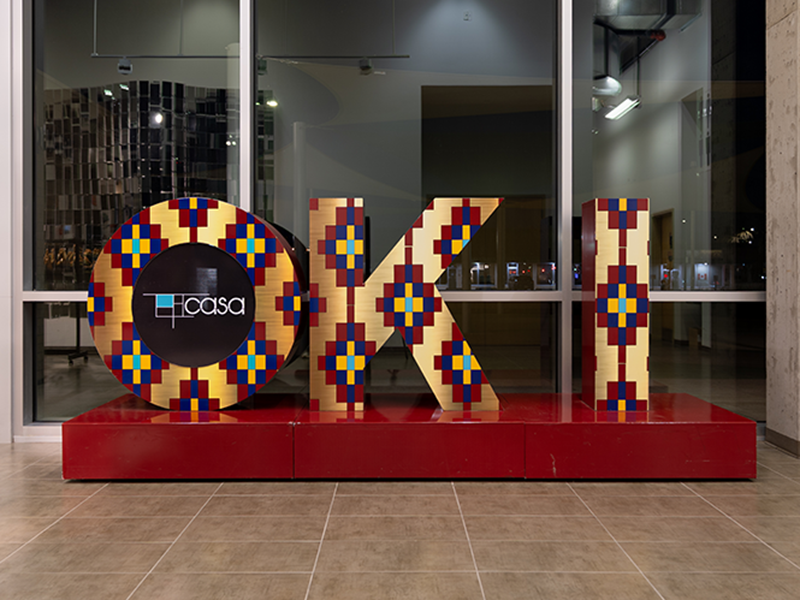
Artist: Aisinai’pi Bullchild (Candace Gladue)
Title: Okan Landscape
Completed: Sep 2022
Location: Casa
The design is inspired by the views of the mountains from the Okan grounds and the land that surrounds Sikoohkotok. The gold colour represents the wild grass that occupies the ground. The yellow, for Naatosi (Sun). The red signifies the people of Kainai (Blood Tribe). The turquoise for the sky and wisdom that the People on the land carry. The artist believes the land takes care of us so it’s important to continue to care and respect the land. If you take, you must act in accordance to maintain balance for there to be peace and harmony.
Artist: Cheyenne (Naatoiyiki) McGinnis
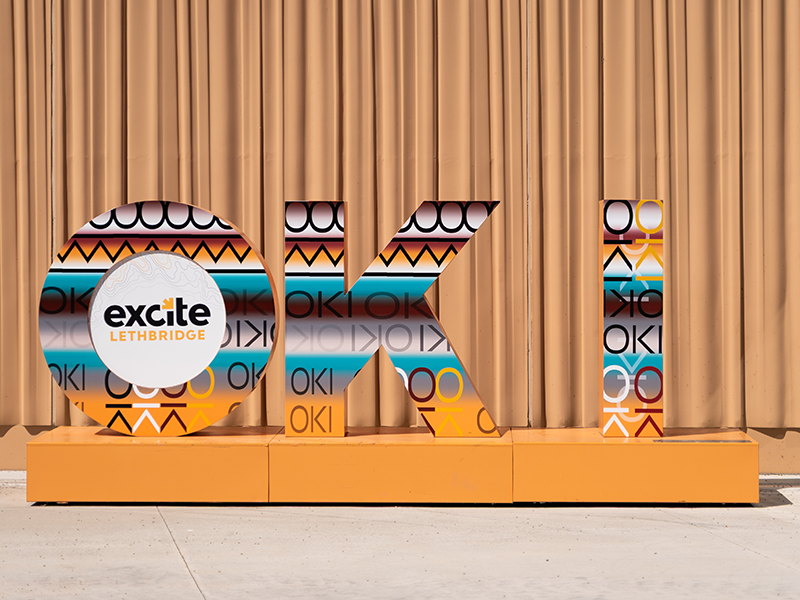
Title: OKI – People and Place
Completed: September 2022
Location: Lethbridge & District Exhibition Complex
Oki means Hello in Blackfoot and is the official greeting for the City of Lethbridge; in this piece, the artist wanted to represent people and place as greetings help to open up conversation between individuals. Resting upon a trade blanket-inspired background, the artist has flipped the word Oki in several ways, so that it is representative of Mountains and People, reminding us of our place as Treaty people in Southern Alberta. The four colours of the medicine wheel are also featured to represent all peoples of Lethbridge and area.
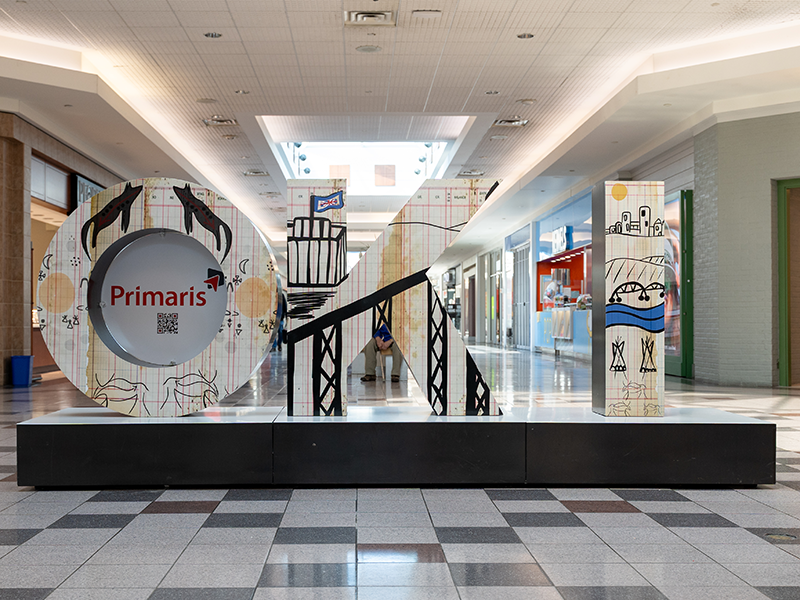
Artist: Cheyenne (Naatoiyiki) McGinnis
Title: A History of Lethbridge, Alberta
Completed: September 2022
Location: Park Place Mall
This piece represents the history of Lethbridge, from the first peoples of the Area, aka the Blackfoot Confederacy, to the coal mining era and fort era of Lethbridge, to modern times where we as individuals live side by side in Southern Alberta. The artist believes it is important to highlight history of a place in any which way you can, and to pay homage to the original inhabitants; highlighting the history of Lethbridge through this piece, the artist hopes others will take an interest in the original inhabitants of this land, and understand the history of Lethbridge better.
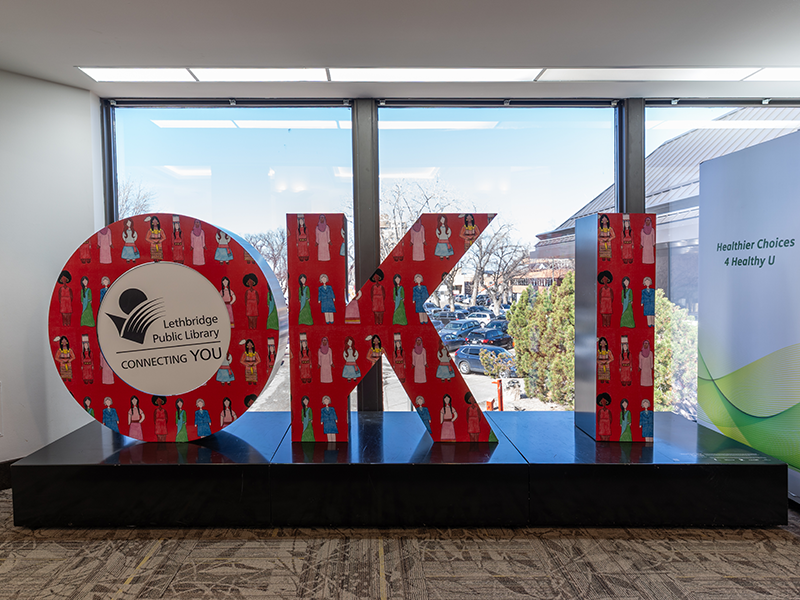
Artist: Sandra Lamouche
Title: Women are Sacred
Completed: September 2022
Locations: Downtown Lethbridge Public Library
“Women are Sacred” is based on the idea of honouring women and bringing awareness to Missing and Murdered Indigenous Women. The artist’s design was inspired by the faceless dolls project and Plains ledger art style. The artist looked at the demographics of Lethbridge and tried to represent the diversity of women in the city.
Artist: Api’soomaahka (William Singer III)
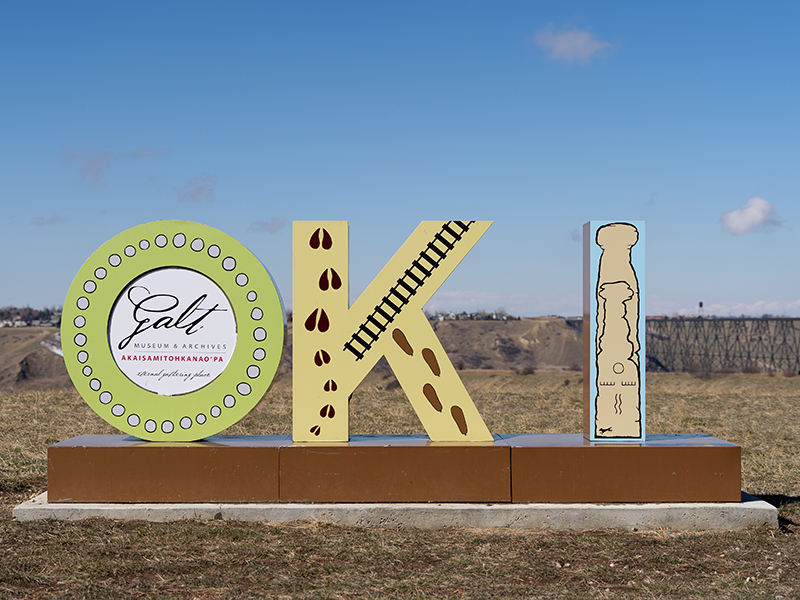
Title: Matapiiksi (People / Hoodoos)
Completed: September 2022
Location: Galt Museum and Archives
Humankind leaves its mark wherever it occurs. No matter where you walk you stumble across history. Footprints criss-cross the landscape as the backbone of colonization moves across the plains. Ohkotok or rock is important in a spiritual aspect, images carved show the progression of time and adaptation of the original peoples.
Artist: Api’soomaahka (William Singer III)
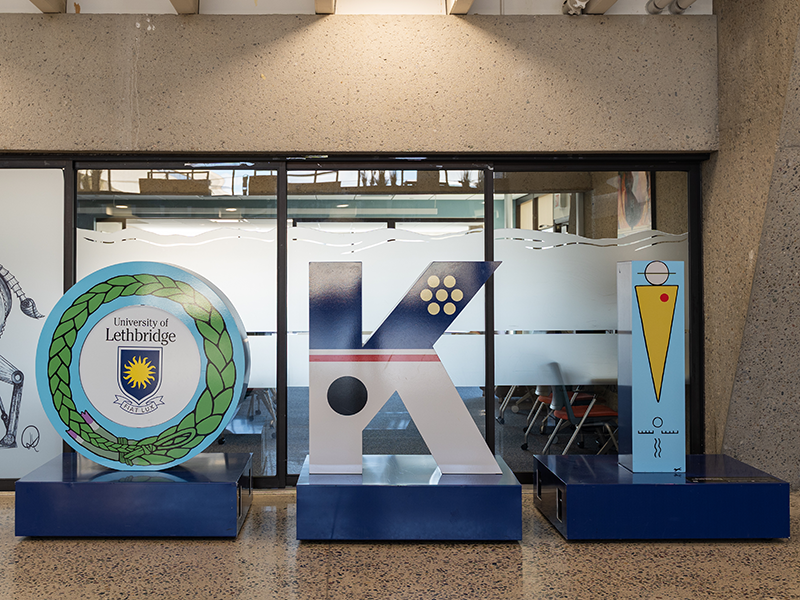
Title: Saakiaitapiiy’pa (We Are Still Living)
Completed: September 2022
Location: University of Lethbridge
The image of the sweetgrass signifies the ongoing spiritual connection with earth and the cosmos. A circle of life is the base of a tipi, secured to the land is the foundation of knowledge. Ohkotok or rock is an important part in creation as it is the bind that made life happen.
Artist: Piikani artist – Wayne Provost Naatosiohpaipiiyi – Sunjumer
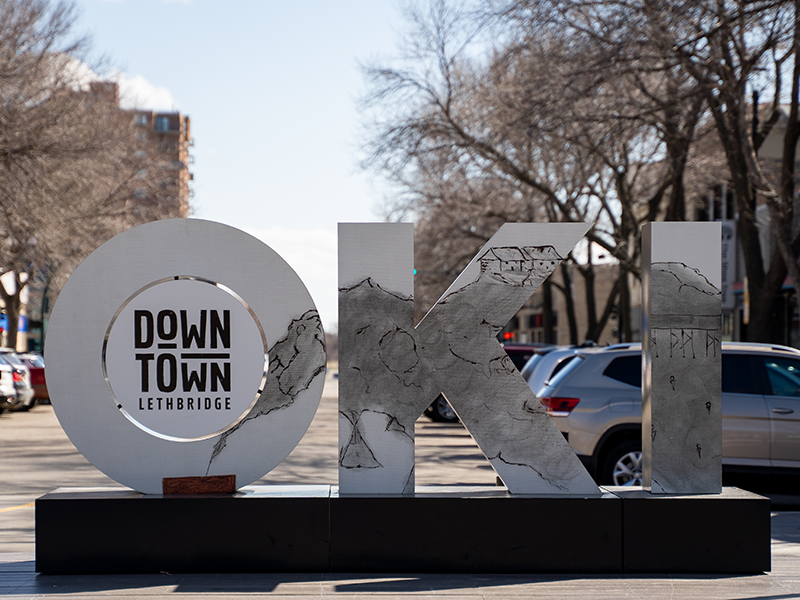
Title: Honor and Smudge
Completed: May 2025
Location: BRZ Festival Square Stage
The translation for Sikoohkiitoki is Blackrock, this was a description of the coal that Lethbridge is famous for. For the Blackfoot people charcoal is a main component to a smudge, and wanted to use it, charcoal, in this piece to pay homage to that practice and custom. I made a smudge and prayed over my art supplies and myself before I started, and then broke down that smudge and used it as the prime item in this piece. So I made the art piece look like smoke is moving from the letter “O” to the letter “I”. This drawing/painting is to honour the community and area of Lethbridge that we live in now and before.
Artist: Mariah (Omah’kaistaawakaakii) Gladstone
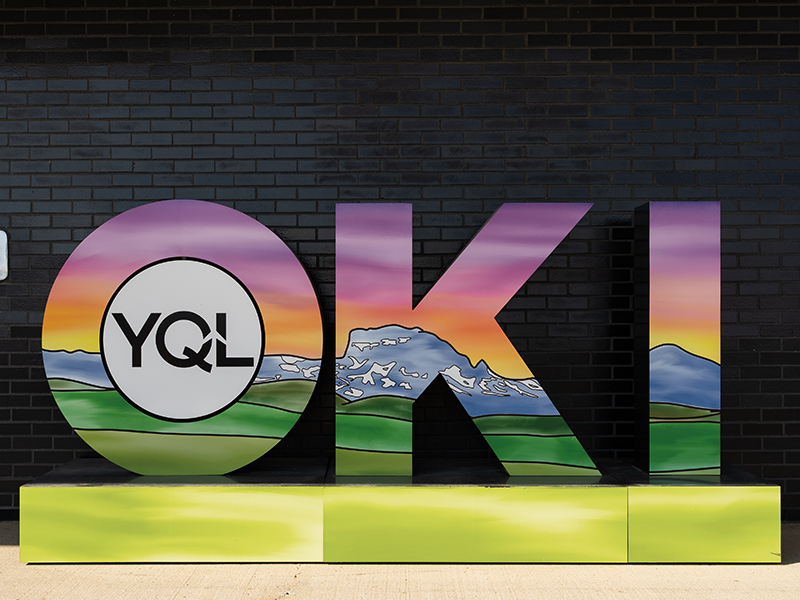
Title: Ninnastako: Chief Mountain
Completed: May 2025
Location: Lethbridge Airport
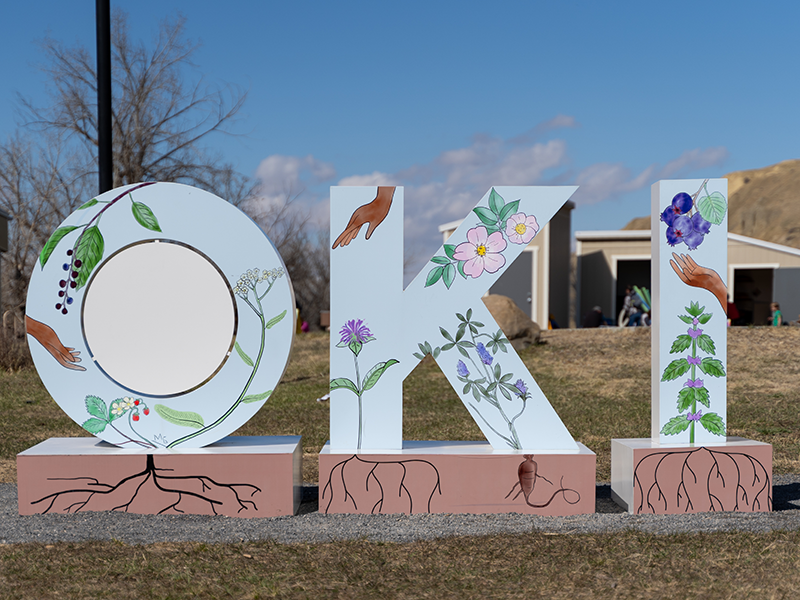
The inclusion of native plants in the sculpture’s design reinforces the theme of “Gathering Together” by highlighting the interconnectedness of all living beings and the importance of preserving and honouring the natural world. Just as the Blackfoot people gather to celebrate their cultural heritage, so too do the plants and animals of Southern Alberta gather in symbiotic harmony, creating a vibrant ecosystem that sustains life. Additionally, these are plants that Blackfoot peoples have “gathered,” as in harvested, for thousands of years. The plants that are featured include chokecherries, wild strawberries, yarrow, bee balm, wild roses, prairie turnips, saskatoon berries, and wild mint.
Artist: Mariah (Omah’kaistaawakaakii) Gladstone
Title: Ohkanaomowoo: Gathering Together
Completed: May 2025
Location: Helen Schuler Nature Centre
This design depicts Ninnastako, Chief Mountain, as seen from the north. It is a view that depicts the center of Blackfoot territory and our homelands. The sky is lit with the colours of a sunset, painting the landscape in a vibrant glow. Blackfoot peoples for millennia, and millennia to come, have and will enjoy this view, even as the world around us shifts.
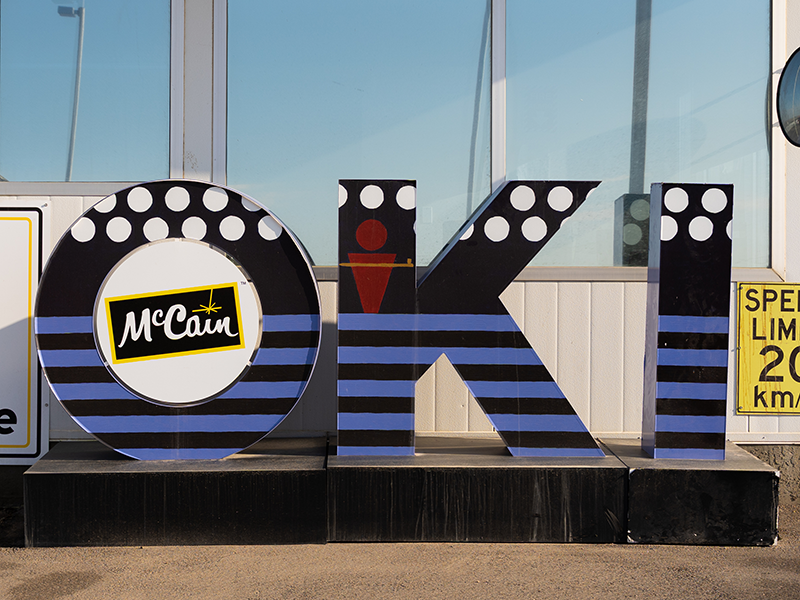
Artist: Serene Weasel Traveller
Title: Water Treaty
Completed: May 2025
Location: McCain Foods
My OKI Sign design concept reflects the theme of Niitsitapiiyisinni, describing how in ancient time the Blackfoot people, the animals, and the environment were closely connected and had the ability to communicate with each other.
A simplified version of the story describes how a Blackfoot man was in love with a beautiful lady. Feeling unworthy to approach her, he left the camp and went to the river. At this time, the weather was getting colder with falling snow, and the man heard a voice. He looked and saw a beaver, the beaver took pity on the sorrowful man and invited him to stay with his family for the winter. The man followed the beaver into his lodge. This was a time when shape-shifting occurred. Throughout the winter, the beaver taught the man a sacred ceremony and gifted the man a sacred gift. When spring arrived, the man left the beaver family and returned to the camp, where he was recognized as a great warrior because of the gift of the beaver. The gift was to honour all the animals and to honour the land and water.
This story came to my mind as we all worried about the water shortage, announced in the spring of 2024, and what the future will look like with respect to the water usage globally. The water shortage, believed to be the result of rapid climate change due to the greenhouse effect and the accelerated burning of fossil fuels emitted into the atmosphere. The process has accelerated since the Industrial Revolution. As Niitsitapi, or Blackfoot people, we have connection to the animals and land through our stories and sacred practices. It is our responsibility to ensure there is clean water for our future generations, for the wildlife, plants, and for the health of the overall environment. My design concept would be to make a painting to reflect that connection; a man is standing on the water with his gift from the animals, with the universe as witness to this treaty.
Artist: Walker English (Piita-Kyatsis)
Title: Untitled
Completed: May 2025
Location: YWCA (Decal – not 3D sign)
Walker English (Piita-Kyatsis) is a Blackfoot-Ukrainian contemporary artist from Treaty 7 territory. Born on the Piikani Nation, Walker is a multidisciplinary artist, having worked in areas such as performance, sculpture, drawing, and painting. The OKI sign design incorporates elements of Blackfoot language in the form of the Blackfoot syllabics for “Oki”. Lethbridge is located on Treaty 7 land, which includes the Blackfoot, Stoney, Nakoda, and Sarcee. The number 7 is hidden within the symbol for “Niitsitapi”, which is an upside-down triangle with a circle floating above. Niitsitapi is a word used by Blackfoot people to refer to themselves. Both the Blackfoot culture and language are oral-based, making learning of the written word difficult due to the complexity of pronunciation.
